Farmers have hope, but seek clarity, on China trade deal
Published in Business News
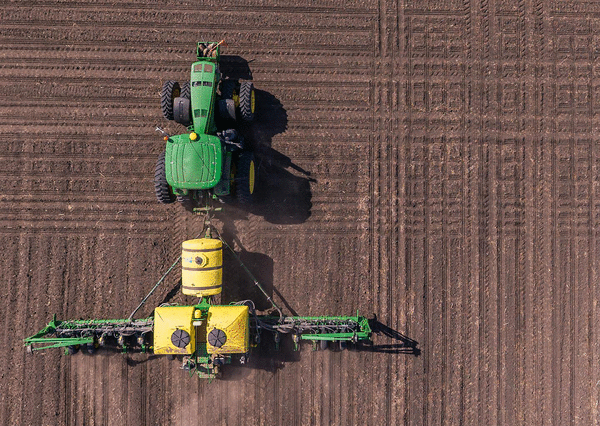
Agriculture leaders said the trade deals struck on President Donald Trump’s trip to China are encouraging.
But whether the export framework that emerged after Trump’s meeting with Chinese President Xi Jinping will result in real deals and lift farmers’ profits remains uncertain.
After the high-profile trip, which included several chief executives, including Cargill’s Brian Sikes, the White House said China agreed to purchase at least $17 billion of American agricultural products in 2027 and 2028, as well as a prorated amount in 2026. That’s on top of the 25 metric tons of soybeans annually the country agreed to buy from U.S. farmers.
China also agreed to accept beef and poultry imports from the United States.
Details are scant, though, including which crops are included in the high-dollar export deal.
“The devil’s in the details. For now, though, let’s celebrate,” said Thom Petersen, Minnesota’s agriculture commissioner. Gov. Tim Walz’s appointee said he was glad to see Cargill’s CEO was on the trip, as it “signals a lot, Minnesota being home to Cargill.”
Cargill declined a request for comment.
The announcement has prompted cautious optimism among Minnesota agricultural leaders, who are eager for a reprieve during a time when war with Iran has inflated farm expenses and crop prices are down from 2022 peaks.
The additional export commitment is also a win for Minnesota-based Cargill, which moves commodity crops around the world.
The U.S. grows more crops than it can consume. China’s reliance on soybeans has diminished in recent years. It appeared China was not going to purchase any soybeans in 2025 during a trade war building between Trump and Xi, but then a breakthrough occurred with the October deal.
“The president was proud to bring home a number of deliverables for the American people from Beijing — including new Boards of Trade and Investment to ensure our country is no longer ripped off by unfair trading practices, expanded market access for farmers and ranchers, and massive aerospace deals that will bring jobs back to our country,” White House spokesperson Anna Kelly said in a statement.
The deal comes after China failed to follow through on purchasing $200 billion in American exports after a deal made during Trump’s first term in 2020.
Tanner Ehmke, CoBank’s lead economist for grains and oilseeds, said commodity traders were hoping for the meetings to produce “actual purchases, not just pledges of potential purchases.”
“Leading into this, there was hope that something would be inked and finalized,” Ehmke said. “Unfortunately, we haven’t seen anything from that vantage point yet.”
U.S. Rep. Brad Finstad, a Republican and a farmer who represents southeastern Minnesota, said the $17 billion in China’s purchase of U.S. farm goods means more “market access for our state’s producers.”
“I will continue to work alongside the administration to ensure China follows through on its commitments,” Finstad said in a statement.
Sen. Amy Klobuchar of Minnesota, the highest-ranking Democrat on the agriculture committee, said after Trump’s on-again, off-again tariffs rattled markets that took generations to build, people are waiting for details of the purchase commitments.
“The goal should be to restore balance and stability in our trade policy and ensure Minnesota farmers can export to the world,” she said in a statement.
Minnesota Farm Bureau President Dan Glessing said farmers are hoping the purchase deals will boost crop prices and revenue.
The U.S.-Israeli war against Iran has had an outsized effect on farmers, and without ships moving through the Strait of Hormuz, higher costs will hinder crop farmers in the fall, Glessing said.
The war has exacerbated already difficult fiscal conditions for farmers.
“The inflationary pressures that we felt over the last four-ish years really have had an effect, and we’re in our fourth year of planting a crop that we didn’t know we were going to make a profit on,” Glessing said.
He said commodity markets fell significantly last week, with little information coming out as the meetings were happening and the crop markets dipped.
But the White House fact sheet laying out the trade deal produced encouragement in Minnesota, Glessing said. The corn and soybean futures markets made a modest recovery to start the week.
“My hope is that we do see those pen to paper,” Glessing said, and deals start to happen.
Wells farmer Darin Johnson, president of the Minnesota Soybean Growers Association, said he hopes to see the U.S. produce a signed agreement with China. He pointed out that follow-through on the 2020 agreement did not occur, slowing down U.S. soybean exports.
With the cost of production high, soybean farmers “can’t afford for this price to fall any further than where it’s at,” Johnson said.
“The one thing that has been consistent with trade with China, unfortunately, has been the inconsistency,” Johnson said, “and we hope that, moving forward, that we can get some consistency.”
©2026 The Minnesota Star Tribune. Visit at startribune.com. Distributed by Tribune Content Agency, LLC.









Comments