Alaska House approves operating budget, setting up final Senate vote as session wraps
Published in News & Features
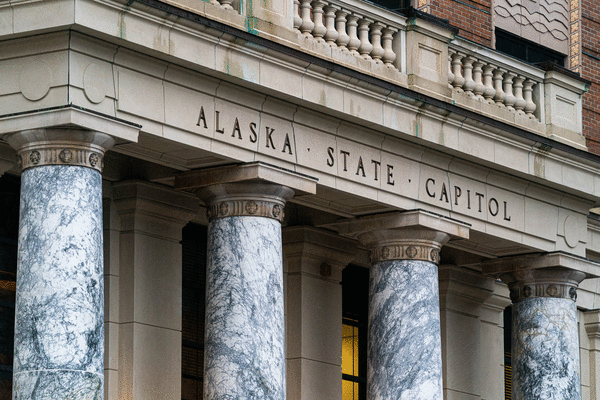
JUNEAU — The Alaska Legislature is poised to adopt a balanced budget on the final day of the regular legislative session, sending Alaskans $1,200 in cash payments.
The House voted Tuesday evening to adopt a $12.8 billion spending plan to fund agency operations and state services. The Senate is expected to take up the vote on Wednesday.
The budget, negotiated between House and Senate leaders, calls for an annual Permanent Fund dividend payment of $1,000 coupled with $200 in energy relief from unexpected oil revenue in the current fiscal year.
It was adopted in the House 21-19 along caucus lines. Republican minority members said they wanted those cash payments to Alaskans to be larger.
Gov. Mike Dunleavy earlier this year called on lawmakers to use a statute that hasn't been followed in years for calculating the annual Permanent Fund dividend, which would have sent roughly $3,800 to every eligible Alaskan. Such a payment would have required lawmakers to drain hundreds of millions of dollars from the state's primary savings account, even after oil prices spiked due to the war in Iran, raising revenue projections.
"We are absolutely swimming in money," said Rep. Will Stapp, a Fairbanks Republican. Yet majority lawmakers "decided that even though we have a massive surplus in our current year's budget, we would not direct that money toward individuals' Permanent Fund dividends and any type of meaningful relief, because we decided we'd spend it on other state programs."
The bipartisan majorities in the House and Senate sought to divert unexpected oil revenue toward a wide slate of state agencies and social safety net programs.
The final budget "considers the needs of all Alaskans," said Rep. Andy Josephson, an Anchorage Democrat who oversaw the operating budget for the House. "From our teachers and students looking for adequate public school funding to those impacted by high fuel costs and disastrous weather events, victims of crime, and citizens who want to be safe, and those who are our most vulnerable. We hear you, and we deliver."
The budget process this year was transformed by the war in Iran. Majority lawmakers spent the first two months of the session pushing to draw from the Constitutional Budget Reserve, a savings account that can only be accessed with support from three-quarters of lawmakers. They saw the draw as essential to cover the cost of basic agency operations.
But the war changed the calculus in March, spiking oil prices and yielding a projection of hundreds of millions of dollars in new revenue to the state.
The price of North Slope crude averaged $67 per barrel during the first eight months of the fiscal year. Since mid-March, it has remained well above $100 per barrel, clocking in above $120 per barrel on Monday.
That increase in oil prices is putting new burdens on Alaskans in the form of higher gas and fuel costs. But it is also expected to yield a windfall to the state treasury.
Majority lawmakers are looking to send a portion of it toward energy relief checks, reserving most for increased funding for schools, greater spending on infrastructure projects and numerous other programs.
The operating budget would add up to $144 million in one-time education funding for K-12 schools, of which $115 million is contingent on oil prices remaining well above initial projections for the remaining six weeks of the fiscal year.
Given the status of the war and its aftermath, "we are absolutely on target to achieve the goals" outlined in the budget, Josephson said.
Next year's budget would remain balanced as long as the price per barrel of North Slope crude averages $74 or higher in the fiscal year that begins July 1.
The budget adds new spending on a variety of services to address war-driven energy costs, including tens of millions of dollars to be shared with cities and boroughs across the state through a community assistance program; $15 million for bulk fuel loans in rural Alaska; and $11 million to restore a lapsed heating assistance program.
Lawmakers also updated some Medicaid reimbursement rates and approved an $8 million increase in funding for a federal food assistance program known as SNAP, after Republicans in Congress — including all members of Alaska's delegation — voted last year to transfer some administrative costs for the program from the federal budget onto states.
In total, the operating budget allocates over $8 billion in state funds and roughly $4.5 billion in federal expenditures. It will be paired with the capital budget, which would send more than $350 million in state funds to infrastructure and maintenance projects. The capital budget passed the House last week and is expected to be voted on for a final time in the Senate on Wednesday.
Even after the Senate's expected budget votes, the state's finalized spending plan for the year won't be known until Dunleavy signs it. Now in his eighth and final year in office, Dunleavy has regularly used the veto pen to nix programs and projects he finds objectionable.
©2026 Anchorage Daily News. Visit at adn.com. Distributed by Tribune Content Agency, LLC.






Comments