Long COVID will cost the US an estimated $8 billion over just 3 years due to healthcare burden, managing symptoms and loss to the workforce
Published in News & Features





Headlines on long COVID have become much more rare than during the first few years of the COVID-19 pandemic.
But that doesn’t mean the more than 44 million Americans who have at some point reported long COVID symptoms – a number that continues to grow – are no longer suffering, or that the U.S. isn’t paying for it.
Long COVID refers to a condition where at least one of the COVID-19 symptoms, such as fatigue, shortness of breath, and headaches, persists for more than three months.
We are artificial intelligence and computational modeling researchers who have been developing and using these methods to aid communications and decision-making in public health. For this study, we worked in a collaborative team of public health and infectious disease experts.
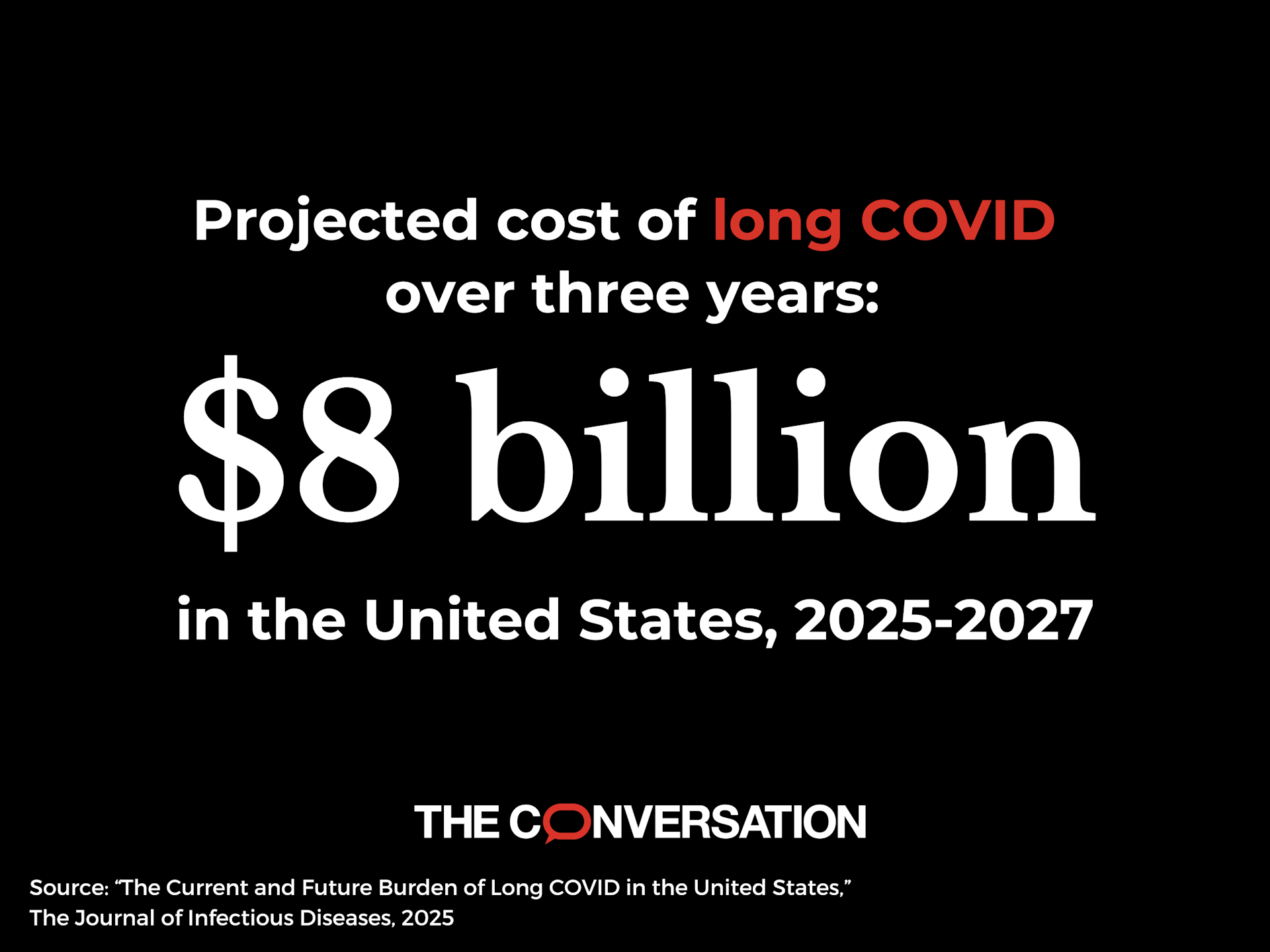
Our team’s study, which was published in 2025 in the Journal of Infectious Diseases, estimated that the total economic burden of long COVID will likely exceed US$8 billion between 2025 and the end of 2027.
This study entailed developing and running a computational simulation model that represented what might happen to each person after suffering COVID-19, including the risk of that person developing different types of long COVID and the resulting symptoms, healthcare costs and lost-work productivity.
Based on our simulations, a single case of long COVID could cost the U.S. an average of between $9,906 and $11,646 annually, with more severe cases costing even more. Productivity losses would account for well over 90% of these costs, which means that employers around the country will be affected.
Studies have suggested that somewhere between 6%-20% of people with COVID-19 will go on to develop long COVID. We then used numbers within this range in our model to then calculate the number of people who have developed long COVID, and therefore had probabilities of suffering different symptoms and accompanying healthcare costs and productivity losses.
Taking the most conservative 6% end of that range and assuming that long COVID symptoms would only last for one year results in an annual cost of $2.01 billion. Increasing this percentage to 10% would push the estimated annual burden to $3.4 billion.
Naturally, the longer that symptoms persist, the higher the total cost. The previously mentioned $8 billion burden for 2025-2027 assumed the 6% incidence of long COVID with symptoms lasting up to three years. This is likely still a conservative estimate, since many who developed long COVID five to six years ago have continued to have symptoms with no clear end in sight. In addition, evidence suggests that long COVID is underdiagnosed and underreported.
Currently, there are no effective cures for long COVID, and treatment entails trying to manage the symptoms as best as possible. It’s also not clear whether and when long COVID symptoms might ever subside.
There is also a severe shortage of long COVID treatment clinics, with far too few to meet the demand for specialized treatment.
Despite the lack of preventive options and the need for more answers, the U.S. is moving further away from being able to effectively manage long COVID.
For example, in the midst of the massive funding cuts in President Donald Trump’s second term, in 2025 the Department of Health and Human Services shuttered the Office of Long COVID Research after only two years of existence. The same year, the National Institutes of Health terminated various funding initiatives for studying potential pathways to and treatments for long COVID.
There is currently no clear national strategy on how to manage long COVID going forward or COVID-19 in general, for that matter. Recommendations on face mask use, indoor air quality measures and who should get vaccinated each year have been ambiguous and changing often since 2021. Such recommendations and regulations have also varied significantly from organization to organization and state to state.
Without any changes, the number of people with long COVID is almost certain to grow, and those with persistent long COVID symptoms could continue to suffer and cost society.
Our study shows literally billions of reasons why all of this is a big problem.
This article is republished from The Conversation, a nonprofit, independent news organization bringing you facts and trustworthy analysis to help you make sense of our complex world. It was written by: Bruce Y. Lee, City University of New York and Hannah Dimmick, CUNY Graduate School of Public Health and Public Policy
Read more:
Long COVID puzzle pieces are falling into place – the picture is unsettling
Long COVID stemmed from mild cases of COVID‑19 in most people, according to a new multicountry study
Black adults with long COVID report higher levels of hopelessness and suicidal thoughts − new research
Bruce Y. Lee has received funding from the National Institutes of Health, the National Science Foundation, the Agency for Healthcare Research and Quality, the Bill and Melinda Gates Foundation, and the Centers for Disease Control and Prevention. He is the founder and CEO of Symsilico and the founder of InSilico Analytics.
Hannah Dimmick does not work for, consult, own shares in or receive funding from any company or organization that would benefit from this article, and has disclosed no relevant affiliations beyond their academic appointment.







Comments