Trump postpones signing AI security order over parts he disliked
Published in News & Features
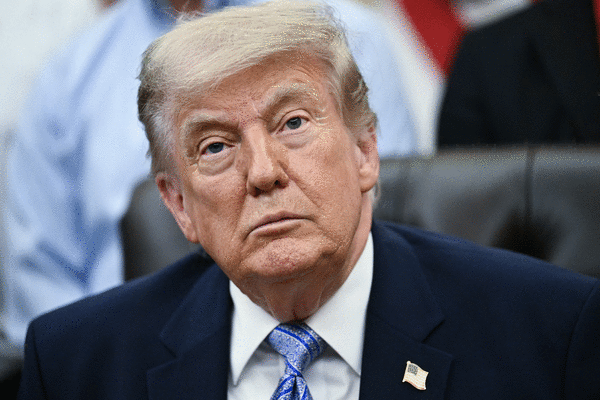
WASHINGTON — President Donald Trump said he called off the signing of an executive order that would address cybersecurity concerns raised by powerful new artificial intelligence models because he objected to parts of the directive, casting doubt on U.S. efforts to respond to new risks posed by the emerging technology.
“Because I didn’t like certain aspects of it. I postponed it,” the president said during an event Thursday at the White House. “I really thought that could have been a blocker, and I want to make sure that it’s not.”
The directive was set to be signed later Thursday by the president, and invitations had been sent to a range of technology industry executives for an event at the White House. Trump said that he wanted to be sure that it didn’t take any steps that would reduce the U.S. advantage over China in AI, though he didn’t specify what changes he wanted to the order.
“We’re leading China, we’re leading everybody, and I don’t want to do anything that’s going to get in the way of that lead,” Trump said.
The move throws into turmoil an administration-wide push to shape policy governing artificial intelligence, a technology that promises to transform the global economy yet also carries a broad range of potential security risks. White House Chief of Staff Susie Wiles, Treasury Secretary Scott Bessent and National Cyber Director Sean Cairncross have all been involved in the effort, along with Trump’s science and technology adviser, Michael Kratsios.
In the works for several weeks, the order would have revamped existing cybersecurity information-sharing programs to include AI companies while stopping short of mandatory federal approval of cutting-edge models, Bloomberg News has reported. Instead, it would have called for voluntary government testing of frontier AI systems to find and patch weaknesses across federal, state and local networks, as well as critical U.S. infrastructure, without requiring extensive new oversight.
The U.S. already runs a voluntary program to evaluate AI systems before their release, and the Commerce Department recently announced an expansion of that initiative. Alphabet Inc.’s Google, Microsoft Corp. and xAI Inc. have agreed to give the government access to their models to assess the systems’ capabilities and help improve security. OpenAI and Anthropic PBC were already part of the program, led by the department’s Center for AI Standards and Innovation.
In addition to sharing its models with the Commerce Department for national security testing, OpenAI’s Chief Global Affairs Officer Chris Lehane confirmed that the company is partnering with the White House and Trump administration on a deployment strategy for GPT-5.5-Cyber, which is designed to bolster cyber defense efforts.
Lehane emphasized long-standing agreements between OpenAI and Anthropic to have the Center for AI Standards and Innovation test its systems in classified environments, telling reporters in Washington last week that “we’ve called for some version of that to actually become sort of a required thing at a national level, as part of national safety standards.”
Trump’s decision comes a month after Anthropic revealed that its breakthrough Mythos model was extraordinarily adept at finding network vulnerabilities and could pose a major cybersecurity threat. The company has limited Mythos access for now to a handful of large tech and Wall Street companies, amid broader global alarm about the new threats it could pose to critical systems.
U.S. officials have been pushing to make Mythos more widely available to federal agencies to test their networks for security flaws, and the National Security Agency has already been using it. White House officials recently rejected Anthropic’s plans to distribute Mythos to several dozen additional companies and organizations, citing security concerns.
-------
—With assistance from Courtney Subramanian and Catherine Lucey.
©2026 Bloomberg L.P. Visit bloomberg.com. Distributed by Tribune Content Agency, LLC.





Comments