Minnesota politicians promised to soften their tone after killing of state lawmaker Melissa Hortman. It didn't last
Published in News & Features
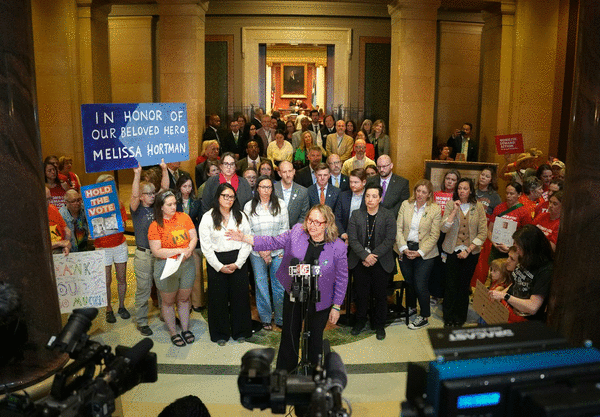
MINNEAPOLIS — Ten months after his parents were assassinated, Colin Hortman met privately with members of the Minnesota House to deliver a message that some lawmakers needed to hear again.
Hortman hoped his visit to the chamber where his mother once presided would help slow the growth of vitriolic political rhetoric. Legislators who had vowed to soften their tone after the June 14 killing of former House Speaker Melissa Hortman and her husband, Mark, were again trading partisan attacks this spring as they debated immigration and school safety.
“It was really powerful to hear his push to us ... that we all have a role to play in terms of not portraying the other political side as the enemy,” said state Rep. Mike Howard, DFL-Richfield.
But the broadsides continued in the weeks afterward, showing how quickly politicians abandoned their calls for civility after the Hortmans were killed. As the anniversary of that attack approaches, many elected officials have returned to the same rhetoric that defined politics before June 14, 2025.
The backslide comes even after more acts of political violence — including the assassination of conservative commentator Charlie Kirk — rocked the nation.
DFL Gov. Tim Walz was among the politicians who pleaded for more civil discourse after last summer’s attacks. Months later, he was criticized for comments in which he seemingly wished for news of President Donald Trump’s death.
Walz said in an interview that he’s tried to watch his language since the Hortman attacks. At the same time, he said, he’s also continued to forcefully push back against Trump.
“I’m not going to meet fascism halfway. I’m not going to meet hate halfway,” Walz said.
Republican U.S. Rep. Tom Emmer co-sponsored a resolution condemning political violence in June 2025.
“We commit to always treat each other with respect, regardless of differing opinions or political affiliations,” Emmer said on the House floor last year.
Since then, Emmer has accused Democrats of catering to the “terrorist wing of their party,” referred to “No Kings” protests as a “hate America rally” and called his fellow congressmember, Democrat Ilhan Omar, a “racist anti-Semite,” among other things.
Emmer’s office did not respond to a request for comment.
The return of combative rhetoric over the past year came as Minnesota lawmakers grappled with additional violence and loss, including the August mass shooting at Annunciation Catholic Church and School and the killings by federal agents of Renee Good and Alex Pretti during Operation Metro Surge.
Minnesota House DFL Leader Zack Stephenson of Coon Rapids said it’s clear that some legislators were struggling after a traumatic year.
“I think you have to factor in degree of difficulty into this conversation,” Stephenson said. “Between June 14, the Annunciation shooting, Operation Metro Surge, you know, those are three events that really turned up the heat dramatically just on their own.”
Tensions boiled over in the final days of the legislative session, when shouting matches erupted on the House floor during a gun control debate.
Democrats were angry with House Speaker Lisa Demuth, R-Cold Spring, for blocking a floor vote on a proposed assault weapon ban. Demuth said the words Democrats yelled at her while on the floor were “some of the most intense and hateful that I’ve ever received directly in a public space.”
“The political climate in Minnesota, I think ... seems even more divided than we were,” Demuth said. “And I think that is a lot to do with grief and just hard events and getting through another legislative session.”
Another confrontation arose during the debate when Rep. Walter Hudson, R-Albertville, said “leftists” were responsible for many mass shootings. Hudson spoke at length against the proposed assault weapon ban, at times yelling and lambasting Democrats who he said were “full of it.”
His remarks prompted Rep. Tina Liebling, DFL-Rochester, to question whether he was sober.
“I could be blitzed and still take you down,” Hudson shot back.
Hudson defended his comments in an interview, saying Democrats provoked him by insinuating that Republicans who opposed the gun ban “don’t care about kids.”
Hudson was among the politicians who pledged to tone down their rhetoric after the Hortmans were killed. A year later, he said he’s no longer interested in doing so. Hudson pointed to the way some Democrats reacted to Kirk’s assassination.
“The issue is a culture that’s willing to tolerate, promote and excuse political violence and violent rhetoric,” he said. “As long as that’s the case, I don’t feel an abiding obligation to soften my tone.”
If lawmakers needed a reminder of last summer’s attacks, they encountered one almost daily in the Minnesota Senate. DFL Sen. John Hoffman and his wife, Yvette, were each shot several times at their Champlin home by the same assailant who killed the Hortmans. Their daughter, Hope Hoffman, was shot at but not injured.
Throughout this year, Sen. Hoffman repeatedly encouraged his colleagues to be careful with their words. In an April committee hearing, he scolded GOP Sen. Glenn Gruenhagen for referring to undocumented immigrants as “illegals.”
“I was shot nine times because we allowed somebody to dehumanize human beings,” Hoffman said. “I almost died twice, Glenn. So I ask you once, please do not say ‘illegal’ in this committee, because it dehumanizes an individual.”
For all the heated exchanges, there have been glimmers of unity.
State legislators shared cordial moments behind the scenes and during committee hearings.
Sen. Julia Coleman, R-Waconia, said some lawmakers let go of long-running feuds after the June 14 attacks. Coleman said she and DFL Sen. Heather Gustafson moved past a previous disagreement in the aftermath.
“June 14, we’re on the phone with each other. At the memorial, we’re hugging each other. We’re checking in with each other,” said Coleman, who was among a group of lawmakers who signed a civility pledge after Hortman’s death.
“Everything kind of got erased, and I’ve seen that in multiple relationships in the Legislature,” she said.
In the final days of this year’s session, lawmakers managed to overcome bitter differences and pass bills to fight fraud in state programs, invest in local infrastructure projects and send aid to the financially distressed safety-net hospital HCMC.
Of all the ways lawmakers have memorialized Hortman in the past year, Stephenson said “the best tribute we could have given to her was getting our work done and getting it done on time.”
“Having such a productive session with an orderly finish, I think, was a really good tribute to her,” he said.
Colin Hortman said political rhetoric had the potential to get “much, much worse” after his mother’s killing. That it didn’t, he said, is a positive.
“I think that my mother’s desk sitting empty made a difference before I was there,” he said. A photo of Melissa Hortman and bouquet of roses sat on her empty desk this spring as a tribute.
“And I hope that I made some difference in the close of [the] session. I truly think that there’s a lot of hope to be gleaned from that.”
_____
©2026 The Minnesota Star Tribune. Visit at startribune.com. Distributed by Tribune Content Agency, LLC.



Comments