Mamdani, NYC schools chief announce plan for smaller class sizes for 2026-27 school year
Published in News & Features
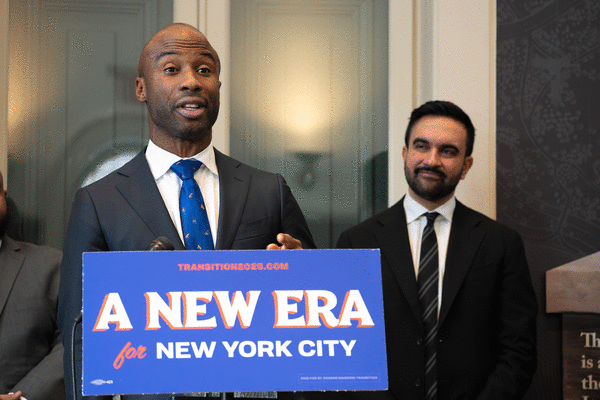
NEW YORK — After persuading state lawmakers to give it more time, New York City Public Schools released a plan to reduce class sizes that allocates $244 million to hire new teachers across 360 schools.
The 68-page draft is required by a 2022 state law, which set the caps between 20 and 25 students, depending on their grade level. City schools were given until 2028 to reach full compliance, but under amendments passed by the state Legislature and expected to be signed into law by Gov. Kathy Hochul, will have until 2030 to phase in the caps.
The allocation is nearly double the investment Mayor Zohran Mamdani announced as part of his executive budget plan last month.
It’s not clear if the new spending is cutting into the half-billion dollars in savings that Mamdani was banking on to help close the city’s budget gap. School spokespeople did not immediately explain either discrepancy.
Officials are still finalizing the number of positions awarded to schools, according to the plan.
Mamdani also earmarked $1.5 billion to create more classroom space, though the report does not estimate how many new seats are needed to comply with the law.
“Delivering smaller class sizes this fall — something every student and teacher deserves — will require real investment, real partnership and real planning,” Mamdani said in a statement.
“That means building the classrooms we need, hiring the teachers our schools deserve, engaging families and educators every step of the way, and pursuing every available path to compliance.”
The new plan claims that school officials and construction authorities for the first time have come up with a “clear path forward” for each school without enough space to comply with the caps in future years. But the blueprint does not specify which schools will receive more space or in how many years.
While about 1,000 schools have sufficient space, there are some 600 schools that don’t.
Of those lacking space, dozens of schools have a solution in place — such as an annex that’s already planned, a capital project that’s already sited, or excess space in a building with several schools that can be reallocated — according to the plan. Many will need new classrooms or larger-scale capital projects that have yet to be sited.
And while education officials are still not proposing any major changes to enrollment for next school year — citing concerns about fewer students matching at their top-choice schools and leaving the city’s school system — the plan opened the door to 45 schools making “small enrollment adjustments.”
Up to 90 schools could be candidates for re-sitings or mergers — a method that Chancellor Kamar Samuels has drawn on in the past, including most recently when he proposed changes to Upper West Side schools that would have created space for an overcrowded school in the district. Those plans are currently on pause.
Some schools, including the city’s specialized high schools, are already exempt from the mandate. Education officials are negotiating with teacher and principal unions about also exempting citywide Gifted & Talented programs.
“Every child deserves access to a high-quality education,” Samuels said in a statement, “and today’s announcement is a meaningful step toward delivering on that promise.”
The $244 million investment in new teachers builds on the $450 million first allocated by former Mayor Eric Adams last year for 3,700 recent hires across 750 schools. The schools that will benefit from the new funding were selected based on economic need, school capacity and current compliance, in that order.
Currently, 64% of classes citywide are in compliance with the new caps, exceeding an annual target of 60% that was only achieved by relying on exemptions. About a third of non-compliant classrooms are only one to three students above the caps.
With an extended timeline set to be signed into law, city schools must reach 70% compliance next school year.
The amendments were passed with the understanding that Mamdani would provide the state with a comprehensive compliance plan. Some advocates on Thursday criticized the blueprint for its lack of detail.
“The state granted the mayor with a two-year extension in return for his promise that he was serious about developing an actual real multi-year plan that would ultimately achieve the goals in the law,” said Leonie Haimson, executive director of the advocacy group Class Size Matters. “Yet none of this is evident in this document.”
“All in all,” Haimson said, “it provides no assurances to parents that Mayor Mamdani was serious about his repeated pledge when running for office that he would lower class size to provide their children with the smaller classes that they need and deserve.”
_____
©2026 New York Daily News. Visit nydailynews.com. Distributed by Tribune Content Agency, LLC.






Comments