What Happened to the Smart Home?
Published in Home and Consumer News
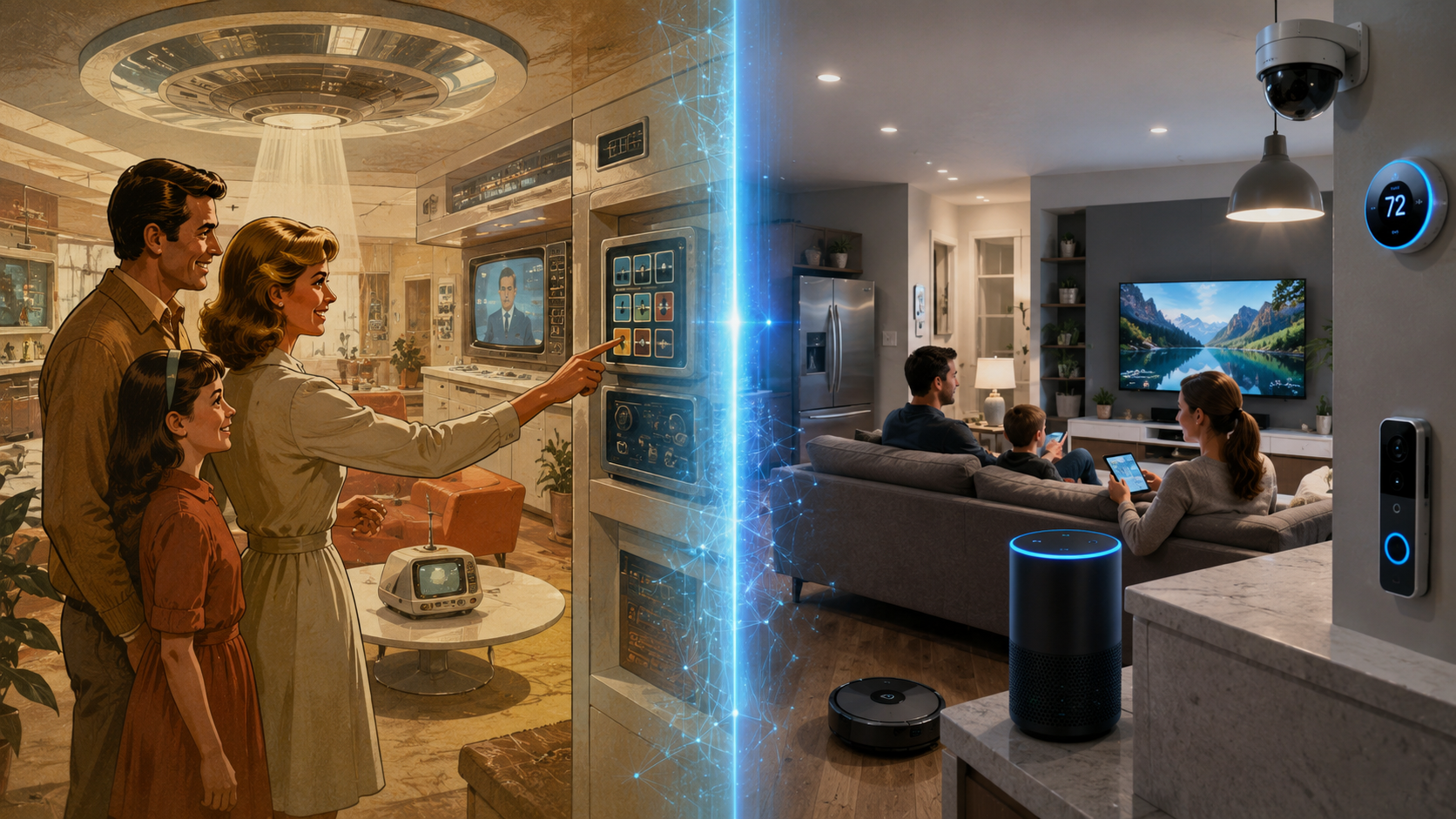
By almost any measure, the smart home should have arrived by now.
For more than 50 years, futurists have promised houses that would anticipate our needs, adjust themselves automatically and free homeowners from countless mundane tasks. In the 1960s, television specials and magazine illustrations depicted suburban families living with computerized kitchens, talking appliances and wall-mounted control panels. In the 1980s and 1990s, the vision evolved into luxury home automation systems with motorized blinds, distributed audio and touch-screen controls. By the early 2010s, with the introduction of affordable voice assistants and Wi-Fi-connected gadgets, it appeared that the long-awaited smart home had finally become a mainstream reality.
And yet, for many Americans, the smart home has settled into something far more modest: a video doorbell, a thermostat, a few smart speakers and perhaps some lights that can be turned on by voice. The fully integrated, almost magical household of popular imagination remains elusive.
The Dream of an Intelligent House
The idea of a home that could think has always been deeply appealing.
A truly intelligent house promises to handle repetitive tasks, improve security, save energy and provide convenience. Lights would follow occupants from room to room. Refrigerators would monitor groceries. Washing machines would run when electricity rates were lowest. Entertainment systems would respond instantly to spoken commands. Heating and cooling would adjust to both weather and human preference.
For technologists, the home also represented an ideal proving ground for connected devices. Houses contain dozens of systems that are potentially automatable, from locks and lighting to irrigation and garage doors.
In practice, however, each of these functions tends to work well enough on its own. The challenge has never been inventing devices that can connect to the internet. The challenge has been making them work together reliably and simply.
Too Many Standards, Too Many Apps
One of the biggest obstacles to the smart home has been fragmentation.
Consumers quickly discovered that each manufacturer often required its own app, account and ecosystem. A homeowner might use one application for lighting, another for security cameras, a third for thermostats and yet another for appliances. Devices from competing brands did not always communicate effectively.
The result was a kind of digital Tower of Babel.
A light bulb should be one of the simplest products in a home. Yet smart bulbs introduced decisions about hubs, wireless protocols, firmware updates and compatibility with voice assistants. What should have been effortless often became a hobby.
Industry efforts such as Matter, a newer interoperability standard backed by major technology companies, are intended to reduce these frustrations. But the market is still in transition, and many households remain a patchwork of partially compatible devices.
The Reliability Problem
Traditional household systems have one enormous advantage: they are dependable.
A mechanical light switch works almost every time with no software updates, account logins or internet connection. By contrast, a smart device may fail because of a network outage, expired password, discontinued cloud service or problematic firmware update.
For many consumers, convenience disappears the moment technology becomes temperamental.
This has led to a growing appreciation for what might be called “appropriate automation” — products that solve a specific problem without introducing unnecessary complexity. A thermostat that quietly saves energy is welcome. A refrigerator that demands software updates is less compelling.
Privacy Comes Home
The smart home also raised questions that earlier generations did not have to consider.
Microphones, cameras and motion sensors can collect a vast amount of information about daily life. Technology companies may know when people arrive home, what time they go to bed and which rooms they occupy most often.
Some consumers are comfortable with this exchange, especially when devices provide tangible benefits. Others are uneasy about placing internet-connected microphones and cameras throughout their homes.
The concern is not merely theoretical. Data breaches, corporate policy changes and discontinued services have reminded users that convenience often comes with trade-offs.
The Smart Home That Actually Emerged
Rather than a single integrated system, the modern smart home has evolved into a collection of practical tools.
Video doorbells have transformed home security. Robot vacuums quietly patrol floors. Smart thermostats reduce utility costs. Voice assistants answer questions, set timers and play music. Streaming devices have replaced shelves of discs and simplified home entertainment.
These products succeed when they address specific, everyday needs.
The grand futuristic vision has not disappeared; it has simply been broken into smaller, more useful pieces.
A House That Serves, Not Distracts
The most successful technology in the home is often the least noticeable.
A good house fades into the background, allowing occupants to focus on family, pets, books, meals and conversation rather than software troubleshooting. In that sense, the smart home may be maturing by becoming less conspicuous and more dependable.
The dream was never really about talking refrigerators or blinking control panels. It was about reducing friction in daily life.
That future has arrived, just not in the dramatic form promised by old science-fiction illustrations. The truly intelligent home may be one that performs its tasks so quietly and effectively that its owners scarcely think about the technology at all.
========
Martin Quill is a technology and culture writer based in coastal Virginia. He covers the intersection of household life, consumer electronics and the enduring promises of the future. This article was written, in part, utilizing AI tools.







Comments