Mark Zeigler: After World Cup hype, hysteria, United States back in an all-too-familiar place
Published in Soccer
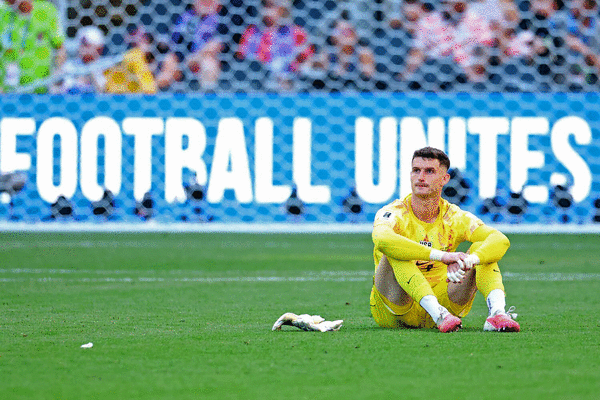
SEATTLE – A talented roster with players at big European clubs, a respected foreign coach with World Cup playing experience, record television viewership, brash talk of transforming the sport in America, a successful group stage, hope, expectation, anticipation, swagger … and then played off the park in the round of 16 by Belgium, population 11.8 million.
We’re not talking about 2026. We’re talking about 2014.
The same exact thing happened 12 years ago.
The tournament was in Brazil, which meant most games aired in prime time in the States during a month when most pro sports are dormant and baseball is mid-way through a 162-game season. The captive audience tuned in, ending the reign of the 1999 Women’s World Cup final as the most-watched soccer game in U.S. history and outdrawing the most recent NBA Finals, NCAA Final Four and World Series.
Then the U.S. lost to Belgium, and everything went back to normal.
Maybe it’s different this time, maybe a corner was turned, maybe a spark becomes a flame. But that’s a big ask for a country obsessed with winning, to care for the 204 weeks before the next World Cup about a national team incapable of doing it at anything approaching elite level.
You can even make an argument that this team regressed despite every conceivable advantage and break, home fields, thunderous crowds, a cupcake draw, own goals, deflected goals, even presidential intervention to reverse a red card.
What, actually, did this team do?
It beat three teams that wouldn’t have qualified for a 32-team World Cup, then surrendered seven goals and lost to the only two teams it faced in the top 25 of the FIFA rankings. It won only the second knockout stage match in its World Cup history, but that was in the new round of 32 against No. 61 Bosnia and Herzegovina, which advanced as a third-place finisher from a weak group.
In 2014, the Yanks survived the proverbial “Group of Death” with Ghana, Portugal and eventual champion Germany. The win against Ghana and tie against Portugal with Cristiano Ronaldo in his prime were more impressive results than anything in 2026.
In 2002, they beat Portugal and Mexico and took Germany to the brink in the quarterfinals. In 2006, a tie against eventual champion Italy. In 2010 and 2022, ties against England teams loaded with Premier League stars.
And in 2014, they actually had a chance to beat a better Belgium side thanks to a record 16 saves from goalkeeper Tim Howard and didn’t because forward Chris Wondolowski missed a sitter at 0-0 late in regulation. Belgium finally breached Howard’s net in extra time and earned passage to the quarterfinals.
On Monday night in Seattle, they should have been down 3-0 in the opening minutes and 5-1 at the half, their lone goal coming on a deflected free kick. The four goals they ultimately conceded were from defensive bungles as much as Belgian brilliance.
“There’s still a lot more that we want to accomplish,” supposed superstar Christian Pulisic said. “We put on some really good performances, for sure. We made it through our group in quite dominant fashion. We won the game against Bosnia, we can for sure be proud of.
“I just think we want to have higher hopes than that. We want to compete with some of the best in the world, and we (still) have that next step to climb. But we’re close.”
History would like a word. No, they’re not.
The federation
The Belgian players came into the interview area at Lumen Field and seamlessly answered questions in Flemish, Dutch, French, English, Italian and Spanish.
It was a symbolic moment of sorts. They are fluent in the language of football. The Americans still aren’t.
The handling of Folarin Balogun’s red card is the latest blunder by a U.S. federation still run by many of the same folks for the past 30 years who still think they’re the smartest people in the room.
FIFA president Gianni Infantino deserves criticism for using a little-known codicil in the rule book to lift Balogun’s automatic one-game suspension for his red card against Bosnia, just as President Donald Trump does for having the hutzpah to ask him to review it. None of this happens, though, if U.S. Soccer doesn’t think it is above the sport and push behind the scenes for what UEFA, Europe’s soccer governing body, called “an unprecedented, incomprehensible and unjustifiable decision.”
Complain all you want about the injustice of his red card. Then leave it at that, serve the prescribed punishment like everyone else and accept the world’s sympathies.
Instead, the federation launched an aggressive appeals process with FIFA while Scott Goodwin, one of the hedge fund billionaires bankrolling Pochettino’s $6 million salary, reportedly phoned his buddy Donald, who phoned his buddy Gianni.
The result was a double serving of karma.
The U.S. team looked tentative, meek, insecure, reactive instead of proactive, like a kid embarrassed that he started an under-12 club game because daddy made a public stink about his playing time to the coach.
And the slumbering Belgium bear, which had underperformed all tournament and seemed ripe for elimination, was duly poked. Players said all the right things to the media afterward in a half-dozen languages, but you didn’t need a translator to understand the video from their locker room: an entire team doing the “Trump dance” to YMCA.
Pochettino
The federation offered him a contract extension through 2030 in the weeks before this tournament started. Good thing he didn’t sign it.
Bullet, dodged.
Because, really, what did he do?
As a host nation, he didn’t have to qualify. He took much of the same roster that Gregg Berhalter did to the round of 16 in 2022, adding an inexperienced defender and a goalkeeper whose horrific gaffe gifted Belgium its third goal that sealed things. Other than a half against Paraguay, he couldn’t squeeze any more productivity from the enigmatic Pulisic. He had an inconsistent overall record, including a pair of losses to Belgium – population 11.8 million – by a combined 9-3.
And he was badly outcoached in the only game of his 21-month tenure that mattered. Belgium counterpart Rudi Garcia shuffled his starting lineup and formation, sitting three of his biggest stars, tweaking how they attacked the American press, and Pochettino had no real answer.
There’s also the dreadful U.S. record of second-cycle coaches. Only one survived to the next World Cup, and he got grouped without winning a match.
“Now is a moment to rest a little bit,” Pochettino said Monday night, “to think, to have conversations and then see what the decision is from the federation and from us.”
Now is the moment to find a new coach.
Europe
Pochettino was asked after the 3-2 loss to Türkiye, his team’s 10th straight against European opposition, why the U.S. struggles so much in the beautiful game against the Old Continent.
“Coincidence, maybe,” he shrugged. “I don’t know.”
It was a common refrain among players too, refusing to acknowledge the national team program’s most defining statistic or outright dismissing it, insulted you’d even ask.
Here’s the stat:
They are 0-11-2 against European opposition not named Bosnia and Herzegovina since 2021. In the World Cup since 1990, they have faced teams from the continent 23 times and won only twice — 3-2 against Portugal in 2002 thanks to a fortuitous own goal and 2-0 against a bad Bosnian team last week. They’re 2-16-5 against European teams and 7-4-1 against everyone else.
Denial isn’t going to change that. It should be a pillar of the federation’s strategic plan moving forward, a key element in hiring a new coach, a focus bordering on obsession.
What do the analytics say? What does the video show? What do other coaches think?
One-third of the World Cup field is from Europe, as are six of the eight quarterfinalists here. You’re going to have to figure out how to beat them.
Player development
We don’t have enough newsprint to discuss the dysfunctional youth system and its inability to produce world-class talent, but look at it this way:
The two best U.S. players in this World Cup were Balogun and midfielder Malik Tillman. Neither grew up in the United States.
Balogun lived here for a month before his Nigerian parents returned to England. Tillman was born in Germany to a German mother and American serviceman father. Both are essentially Europeans representing their second-choice national team thanks to citizenship loopholes.
They never had orange slices at halftime, never got a medal for finishing third in the bronze division of a four-team Labor Day bracket, never got cut from a team because their birthday wasn’t close to the cutoff date or they hit puberty late.
Several other U.S. starters have similar stories — Sergino Dest in the Netherlands, Antonee Robinson in England. Others grew up in the States but left for European clubs in their mid- teens.
Detecting a pattern?
Former U.S. national coach Jurgen Klinsmann is fond of saying the youth development system is “upside down.”
Here, youth clubs are paid by parents and are financially incentivized to keep underperforming players on bloated rosters so the checks keep coming. Everywhere else, youth clubs are paid by pro clubs for contractual rights to their top prospects, incentivizing them to develop the best players instead of the U-10 State Cup champion.
Here, travel ball is driving three hours and staying in an overpriced hotel in windswept Lancaster for an under-10 State Cup game against a team from down the street. There, travel ball is getting up at 5 a.m. to ride three city buses to practice on a rutted field in hand-me-down cleats.
Here, soft kids from the ’burbs with a tangle of third-place medals hanging from their bedroom doorknob.
There, hardened kids who live and breathe soccer so their family can afford a home with a bedroom.
Good luck changing it. The people with the power to do so are the ones cashing the checks.
Pulisic
“Just not quite good enough from us,” Pulisic said afterwards.
Or from him.
The face of American soccer — not just on the field but on seemingly every halftime commercial — has now played eight career World Cup matches. He has scored once and limped off with injuries three times.
“I felt really good this summer, I felt my level was high,” said Pulisic, who had 11 first-half giveaways Monday. “It’s disappointing I didn’t quite have the moments I was hoping to and try to help us really push and get over this next step.”
Pulisic created a stir when he skipped the Concacaf Gold Cup last summer so he could be fully rested for the World Cup, and indeed his first half against Paraguay was scintillating. Then he limped off with a calf injury, sat out against Australia and was never the same, never a factor, before limping off yet again.
“I mean, I just twisted my ankle, sprained my ankle,” Pulisic said. “It’s just frustrating to end like that, of course, but now I get time to rest so hopefully it will be OK.”
To which former women’s national team player Sydney Leroux tweeted: “He rested the entire World Cup.”
Teams generally go only as far as their biggest star takes them. He’ll be 31 at the next World Cup, assuming he’s healthy. It may be time to anoint a new savior.
Defense
Past U.S. teams relied on the back line and goalkeeping. This one was the opposite, with talent in attack and Swiss cheese behind them.
The 2-0 win against Australia was their first clean sheet in 10 matches. Two matches later, they had another against Bosnia and puffed out their chests in interviews, talking about how the talk of their inadequacy was misguided.
Apparently not.
That 38-year-old Tim Ream was not only back for another World Cup but started speaks volumes about the lack of depth and development at the position. Even Chris Richards, who has shown so much promise, was shredded Monday night.
But perhaps the most glaring regression is between the posts. The position caters to American athletic strengths — tall, agile, good hand-eye coordination. Brad Friedel, Kasey Keller and Tim Howard all had long careers in the Premier League.
Now we have Matt Freese and, in 2022, Matt Turner. Both were considered average college keepers who developed late and represent a stark drop in level from their predecessors.
Worse, the modern game demands goalies play with their feet – something not conducive to a youth system that sticks the basketball player with good hands in goal. We saw Monday what happened when Freese ventured out of his penalty box and could no longer use his hands.
“This moment stings more than probably any other moment in my life,” Freese said. “I know this is a step along a longer journey. I know there are big things to come from this federation and this group. This is one step and it’s a painful step, but it’s a step regardless.”
A step isn’t always forward. Sometimes it is sideways or backwards.
____
©2026 The San Diego Union-Tribune. Visit sandiegouniontribune.com. Distributed by Tribune Content Agency, LLC.






Comments