Dennis Anderson: Mysteriously, from spring to fall, some ruffed grouse go missing
Published in Outdoors
MINNEAPOLIS — The beauty of upland hunting is knowing which wild lands produce which wild birds, and where.
Sharptails and prairie chickens inhabit the West’s vast expanses of big bluestem and wheatgrass, while pheasants often linger closer to corn and other crops, in Minnesota and elsewhere.
In western North Dakota, and into Montana and Saskatchewan, where small grains thrive on vast, flat lands divided by rugged draws, Hungarian, or gray, partridge clamber in willow bunches and along hedgerows of weatherbeaten homesteads.
Apart from these, and arguably more glorious, are ruffed grouse, which many uplanders consider the King of Game Birds.
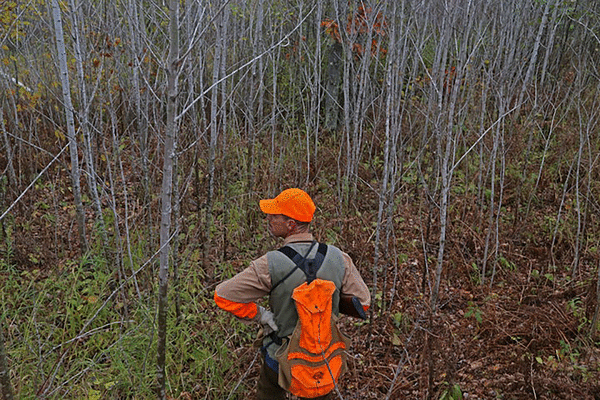
Wary as sentries, these spectacularly feathered fowl are pursued most joyously just now, in late October, as hunters swing 20 gauges, and sometimes 28s, beneath canopies of chromatically hued leaves — aspen, birch and ash, and oaks and maples.
For decades, Minnesota wingshooters have reveled in the best ruffed grouse hunting available anywhere, thanks in large part to near limitless acreages of public forestland up north.
The New England states, and Pennsylvania and West Virginia, once were home to the nation’s most storied ruffed grouse hunting. But forests there have grown old and lack the vibrancy that logging of the kind that has occurred in Minnesota can provide to certain wildlife. Ruffed grouse and woodcock, or timberdoodles, are among species that benefit from timbering, as are deer, moose and songbirds such as golden-winged warblers.
But there’s a problem with Minnesota’s ruffed grouse, and it’s not related to the bird’s approximate 10-year population cycle, during which its numbers rise and fall fairly predictably.
Instead, some ruffed grouse are disappearing, mysteriously, during Minnesota summers. Or they’re not being produced in numbers that match historical norms.
“We don’t know what could be affecting survival of grouse over the summer,” said Department of Natural Resources research scientist Charlotte Roy, who is based in Grand Rapids. “It could be West Nile disease. It could be predators. Or weather. Or a combination of these or other factors.”
Jerry Kolter has seen the disappearing act for a decade or more.
A bird-dog trainer who with his wife Betsy Danielson owns Northwoods Bird Dogs in Sandstone, Kolter is a ruffed-grouse hunting guide who spends most autumn days in Minnesota’s North Woods.
With three dogs working ahead of him, and a couple of hunters alongside, Kolter covers a lot of ground.
“Yesterday (Wednesday) we walked 11 miles and we moved eight grouse,” he said. “That’s not nothing. But compared to the 1980s and into the ’90s, it’s down quite a bit.”
John Zeman of Zimmerman lives what could be called a ruffed grouse lifestyle.
In summer, he field-trials his English setter and pointer, and in fall he’s up north, following his charges into dogwood thickets and stands of birch and aspen, looking for ruffed grouse.
Last week, he hunted north of Bemidji.
“I got my first German shorthair when I was 15,” he said. ”I’ve been a dog guy ever since. As for grouse, I’m not seeing the brood sizes I used to. Maybe right after the hatch the numbers are there. But as summer goes on, I don’t see them. What the problem is, I don’t know.’’
Roy said that according to the DNR’s spring drumming counts — in which trained observers listen for the bird’s distinctive wing-beating sound — hunter harvests should be higher in fall, a disparity that first showed up in the early 2000s.
Records of birds killed during an annual northern Minnesota hunt conducted by the Ruffed Grouse Society also show a difference between drumming counts and harvest, she said.
In 2018 and 2019, Roy undertook a project to determine what effect West Nile disease might have on ruffed grouse. A total of 273 grouse were contributed to her study by hunters the first year, and 316 the second. In both years, about 12.5% of the birds carried antibodies consistent with West Nile, but none had active infections.
While the studies proved some birds can survive the disease, it didn’t determine whether other — perhaps weaker or younger — grouse died of the affliction during summer.
Bob St. Pierre grew up in the Upper Peninsula of Michigan, where he hunted ruffed grouse beginning at age 7. A Twin Cities resident now, he’s hunted grouse 12 days so far this fall and killed 10 birds.
“I’m moving three or four birds for every six hours of hunting,’’ he said. “In a more normal year, I might move 12 birds in that time.’’
In an attempt to determine what’s happening to ruffed grouse in summer, Roy has formed a collective of state, federal and tribal forest workers to document grouse they see while in the woods in summer.
The research, Roy said, hasn’t definitively documented a summertime loss of birds. But she’s hoping sightings from the study’s 43 cooperators might some day help explain why grouse aren’t surviving from spring to fall in numbers they once did.
Wildlife photographer Bill Marchel hasn’t seen a young grouse for four years on the 80 acres surrounding his Fort Ripley home. He cultivates habitat on the property to benefit grouse, deer, ducks and other critters.
“A lot of people say it’s wild turkeys that are killing grouse,’’ he said. “There’s no scientific evidence of that. And at least in the Brainerd area, habitat doesn’t seem to be the issue; there’s a lot of logging going on. To me, however, when logging happens, it might help if drumming logs were left. I’ve made four of them in recent years, and every one of them has been used by grouse.’’
Marchel also suggested grouse might benefit if DNR foresters offered smaller logging sites for sale, like those favored by the late ruffed grouse researcher and expert Gordon Gullion.
Said Zeman: “Minnesota still has the best grouse habitat and grouse hunting there is. It’s just not as good as it once was.’’
____
©2026 The Minnesota Star Tribune. Visit startribune.com. Distributed by Tribune Content Agency, LLC






Comments